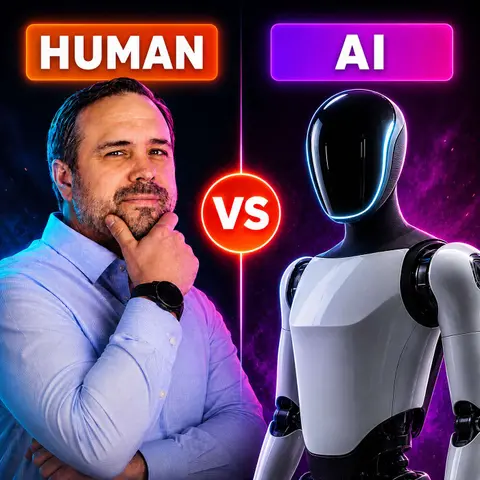
Drafting vs. Deciding: Where to Draw the Line with AI in Your Business
Welcome back to the blog companion for Business Growth Talks! If you have been keeping up with our recent audio content, you know we have been spending a lot of time dissecting the rapid evolution of artificial intelligence and its place in the modern entrepreneurial landscape. In a recent solo episode, I dove deep into a personal and somewhat cautionary tale regarding the promises and perils of modern automation. If you have not listened to it yet, I strongly encourage you to check out the episode Should AI be making YOUR decisions for you? With Host, where we unpack why drawing a hard line between drafting and deciding is the single most important operational task for business owners today. In this post, we are going to expand on those themes, giving you a comprehensive roadmap for integrating tools like ChatGPT and Claude into your workflow without accidentally handing the steering wheel of your enterprise over to an algorithm.
Introduction: The Promise and Peril of Modern AI
We are living through a technological revolution that moves at a breakneck speed. Every single week, a new software update, a smarter language model, or an automated workflow promises to save us hours of work. For busy entrepreneurs, solopreneurs, and corporate leaders, this feels like a dream come true. Who wouldn't want a virtual assistant available twenty-four hours a day, seven days a week, ready to draft emails, summarize long reports, or brainstorm marketing copy in a matter of seconds?
However, this incredible convenience comes with a hidden trap. When technology becomes so good at sounding human, it is dangerously easy to forget that it is not human at all. As business owners, we face a daily temptation to delegate not just the tedious tasks, but the profound strategic choices that shape our brands. This brings us to the core dilemma of our current technological era: the slippery slope between using AI to draft our path forward versus letting AI decide our ultimate destination. To protect our company's integrity and long-term vision, we must establish a clear boundary between operational drafting and strategic decision-making.
Why AI is an Amazing Tool for Efficiency
Before we look at the risks of over-automation, let us be entirely clear about one thing: modern artificial intelligence is an astonishingly powerful asset for efficiency. Pretending otherwise helps no one. Tools like Claude, ChatGPT, and specialized industry applications have fundamentally changed what a single person can accomplish in a standard workday.
Think about the sheer volume of administrative friction that drains our energy on a daily basis. Responding to routine customer inquiries, formatting data, organizing meeting notes, outlining blog posts, and structuring initial drafts of marketing materials used to consume a massive chunk of our time. Today, an intelligent language model can generate a high-quality first pass of these materials in under ten seconds. This frees up precious cognitive bandwidth, allowing business leaders to step away from the weeds and focus on the bigger picture.
When used correctly, AI acts as an accelerator. It takes the heavy lifting out of the blank page syndrome. If you need to draft a complex policy document, structure a project timeline, or brainstorm fifty catchy subject lines for an upcoming email campaign, AI can deliver a diverse array of options instantly. This acceleration allows small teams to punch well above their weight class, competing with larger organizations by leveraging technology to bridge the resource gap.
Drafting vs. Deciding: Understanding the Boundary
Despite these incredible capabilities, a massive chasm separates drafting from deciding. This distinction forms the absolute bedrock of a healthy, sustainable business strategy in the age of automation.
What does drafting mean in this context? Drafting is the generation of raw material, options, text, code, or structures. It is the initial creation phase where options are put on the table. AI excels at drafting because it can instantly synthesize vast amounts of historical data, patterns, and linguistic structures to produce coherent outputs.
Deciding, on the other hand, is an entirely different beast. Deciding involves taking accountability, weighing ethical implications, understanding nuanced human relationships, feeling the emotional weight of a choice, and anticipating unforeseen long-term consequences. A decision requires skin in the game. It requires a conscience, intuition, and lived experience—qualities that lines of code and neural networks simply do not possess. When you confuse drafting with deciding, you invite disaster into your operations. You might let the machine write the email, but you—and only you—must decide whether sending that email is the right move for your client relationship.
The Dangers of Full Automation and Over-Reliance
One of the most concerning trends in the modern business world is the race toward full automation. Driven by the allure of passive income and frictionless operations, some entrepreneurs attempt to remove the human element from almost every facet of their enterprise. They automate customer service chats, content publishing, lead qualification, and even sensitive client communications, rarely checking the outputs before they go live.
As discussed in our recent podcast episode, this level of complete automation is not true efficiency; it is sheer neglect. When you rely too heavily on automated systems without human oversight, you create invisible ticking time bombs within your brand. AI models are prone to hallucinations, tone deafness, and a complete lack of contextual awareness. A piece of software does not care if your brand reputation takes a hit because it generated an inappropriate or factually incorrect response to a loyal customer.
Furthermore, over-reliance on artificial intelligence erodes your own critical thinking skills as a leader. If you outsource your problem-solving capabilities to an algorithm, your personal muscle for strategic thought begins to atrophy. When a genuine crisis hits—and in business, crises always hit—an over-automated leader will find themselves unequipped to navigate the nuance, empathy, and decisive action required to save the day.
Three Critical Elements Only Humans Can Bring
To truly understand why human intervention remains non-negotiable, we must examine the three critical elements that only human beings can bring to the business table:
1. Empathy and Emotional Intelligence
Business is fundamentally about people. Whether you are managing a team of employees, negotiating with a high-stakes vendor, or supporting a distraught client, human relationships rely on genuine empathy. AI can mimic empathy by stringing together polite phrases, but it cannot genuinely feel or understand human emotion. It cannot read the subtle micro-expressions in a boardroom or sense the underlying tension in a client's voice. True leadership requires emotional intelligence to navigate these delicate moments with grace.
2. Accountability and Moral Responsibility
When an automated decision goes terribly wrong—when an algorithmic bias harms a customer, or a poorly vetted contract clause destroys a partnership—who takes the blame? The software company will not step up to accept legal and moral responsibility. The accountability stops with the business owner. Because humans are the ones who bear the consequences of failure, humans must be the ones steering the ship. True authority cannot be outsourced to a tool that has no skin in the game.
3. Contextual Nuance and Intuition
Human beings possess a lifetime of accumulated intuition and context that algorithms cannot replicate. We understand the unwritten rules of our industries, the idiosyncratic behaviors of our specific communities, and the subtle cultural shifts happening in real-time. While AI can analyze past patterns, it struggles to adapt wisely to unprecedented situations where the old rules no longer apply. Human intuition often bridges the gap between data and wisdom.
AI as Your Co-Pilot, Not Your CEO
How do we find the sweet spot? The answer lies in shifting our perspective on what artificial intelligence is meant to be in our organizations. We must view AI as a co-pilot, not the CEO.
Think about the aviation industry. Modern commercial airplanes are packed with incredible autopilot technology. Planes can navigate across oceans, maintain altitude, and even land autonomously under the right conditions. Yet, no airline would ever dream of flying a passenger jet without experienced human pilots sitting in the cockpit. Why? Because unexpected weather patterns, mechanical failures, and complex anomalies require real-time human judgment.
Your business operates the exact same way. Let AI handle the autopilot duties of drafting, organizing, and summarizing. Let it crunch numbers and generate initial options. But you must keep your hands on the yoke. You must review the flight plan, monitor the weather, and make the executive decisions when turbulence hits. By positioning AI as a supportive co-pilot rather than an autonomous leader, you get all of the efficiency gains without risking the safety of your enterprise.
Final Takeaways for Balancing Technology and Human Judgment
As we navigate the future of business, artificial intelligence will only become more integrated into our daily workflows. The winners in this new era will not be the companies that automate everything, but rather the leaders who strike the right balance between technological leverage and human wisdom.
Remember these core principles as you refine your operations:
- Use AI aggressively for drafting, brainstorming, and administrative efficiency.
- Keep critical decision-making firmly in human hands where accountability lives.
- Guard against the trap of over-automation by implementing mandatory human review checkpoints.
- Nurture your own strategic thinking skills rather than letting them atrophy.
If you are ready to take a deeper dive into these concepts and hear a candid breakdown of how to protect your business from the perils of over-reliance on tech, make sure you listen to the full podcast episode. Head over to Should AI be making YOUR decisions for you? With Host to get the complete audio breakdown and start transforming the way you use AI in your company today!
Stop Losing Money: Why Your Business Needs a Structured Follow-Up Process